

Is Buy to Let Halal? A Shariah Guide for UK Investors
Conventional buy to let almost always involves riba. But halal property investment does exist. Our free educational guide explains the Islamic finance principles behind Shariah-compliant property and what to look for in a genuinely certified opportunity.
- Why conventional mortgages contain riba and what that means in practice
- How sukuk and murabaha structures generate halal returns
- What independent Shariah certification should actually include
- Risk factors every Muslim investor must understand before committing capital


Download Your Free Shariah Property Guide
Instant access to our full guide on halal property investment in the UK, including the Shariah certification rationale and current opportunities.
Islamic Finance Education
Accessible entry point
Target Profit Rate P.A.
Profit not guaranteed. Capital at risk.
Month Terms Available
Flexible investment horizons
What Muslim Investors Are
Asking About Property
Property is the UK's most common wealth-building vehicle, but conventional structures almost always involve riba. These are the questions we address in the guide.
Is a buy to let mortgage permissible in Islam?
Conventional mortgages are structured around interest, which is explicitly prohibited as riba. The guide explains precisely how interest appears in standard buy to let financing and what the Shariah-compliant alternatives look like in practice.
Can I earn property returns without riba?
Yes, through correctly structured instruments such as sukuk and murabaha. Halal returns flow from genuine commercial activity in the underlying asset, not from the act of lending money at interest.
What does Shariah-certified actually mean?
Not all "halal" investment claims are independently verified. The guide explains what a credible certification process should involve, which bodies carry scholarly authority, and the specific questions to ask before committing any capital.
How does property development avoid gharar?
Gharar refers to impermissible uncertainty or ambiguity in a contract. The guide explains how asset-backed UK property development avoids speculative structures, and what level of disclosure you should expect from any certified provider.
Six Things You Will Understand
After Reading This Guide
Written in plain English for Muslim investors who want to understand Islamic finance principles in the context of UK property, without needing a background in finance or Fiqh.

What riba is and why it matters
A clear, non-technical explanation of why interest is prohibited and exactly how it appears in conventional UK property investments.

How sukuk and murabaha work
Plain-language explanations of the key halal instruments used in Shariah-compliant UK property investment and how returns are generated.

What to look for in a certification
The specific questions to ask any investment provider to verify their Shariah compliance credentials before you proceed.

How halal returns are generated
The mechanics of profit-sharing from genuine asset-backed property development, and why this differs fundamentally from interest income.

The risks you must understand
Honest disclosure of the risks involved, including capital risk, development delays, and how Shariah compliance does not remove investment risk.

UK development opportunities available now
An overview of the current Shariah-certified development pipeline in the South West of England and South Wales.
From Guide to Investment in Four Steps
Accessing a Shariah-compliant property investment is straightforward.
Here is the process from first enquiry to receiving profit distributions.
Download the Guide
Complete the form above to receive the free Shariah property investment guide, including full certification documentation.
Certify Investor Status
Confirm you meet the eligibility criteria as a High Net Worth or Sophisticated Investor under FCA guidelines.
Review the Opportunity
Speak with the team to review the current Shariah-certified development pipeline, terms, and risk disclosures in full.
Receive Profit Distributions
Once invested, receive regular profit distributions structured in accordance with sukuk and murabaha principles.
What Makes a Property Investment Genuinely Shariah-Compliant?
There are five non-negotiable elements that must be present. Our guide explains each one and how they apply to UK property development specifically.
-
No riba (interest)
Returns must be generated through profit-sharing in a genuine commercial transaction, not through lending at interest. Profit-sharing structures underpin all distributions.
-
Asset-backed structure
The investment must be tied to a tangible, real-world asset. In this case, UK residential property development in the South West and South Wales.
-
No gharar (excessive uncertainty)
Contracts must be clear and transparent. No ambiguity in terms, profit rates, or the nature of the underlying asset is permissible.
-
No maysir (speculation)
No derivatives, no conventional debt, and no speculative trading. All returns flow from genuine property development activity.
-
Independent Shariah certification
The structure must be reviewed and certified by qualified Islamic scholars, not self-assessed by the investment provider.
Amanah Advisors
Amanah Advisors is a globally recognised Shariah advisory and consulting firm. The investment structure has been reviewed and certified by their scholars to ensure full compliance with Islamic finance principles, including sukuk structure, murabaha rationale, and asset-backing requirements.
View Shariah CertificateCommon Questions About
Halal Property Investment
Conventional buy to let using a standard mortgage is generally considered impermissible under Islamic law because it involves riba (interest). However, property investment structured through Shariah-compliant instruments, such as sukuk or murabaha, can be permissible. The key is in how the investment is financed and structured, not in the underlying asset itself.
Riba refers to any predetermined excess charged in exchange for money lent. In conventional property investment it appears in mortgage interest payments, interest-bearing savings accounts used to fund purchases, and fixed-return structures that guarantee a yield regardless of actual asset performance. The guide explains how halal structures avoid each of these.
Sukuk is an Islamic financial certificate structured so that the investor holds a share of ownership in a tangible underlying asset rather than receiving interest on a loan. Returns flow from the economic performance of that asset. The free guide covers the specific sukuk structure used and how it has been reviewed by Amanah Advisors.
Murabaha is a cost-plus financing arrangement where an asset is purchased and then sold on at a disclosed profit margin. Because the profit derives from a genuine commercial transaction rather than from lending, it is permissible under Islamic law. In the context of property development, it allows returns to be structured without recourse to conventional interest.
The investment structure has been independently reviewed and certified by Amanah Advisors, a globally recognised Islamic finance and Shariah advisory firm. Their scholars have assessed the contract structure, profit distribution mechanism, and underlying asset basis. The full Shariah certificate is available to download in the free guide.
Capital is at risk and returns are not guaranteed. Property development is subject to planning delays, construction cost overruns, and market conditions that can affect both timelines and outcomes. Shariah compliance addresses the permissibility of the structure, not the commercial risk. The guide includes a full risk disclosure section and scenario modelling. This is not financial advice. Please seek independent financial advice before investing.
The fundamental difference is the source of returns. Conventional property investments typically involve interest-bearing debt, leveraged rental income, or speculative capital gains. Shariah-compliant structures generate returns from genuine property development activity, with profits distributed under a sukuk and murabaha framework. There is no interest, no derivatives, and no speculative exposure built into the structure.
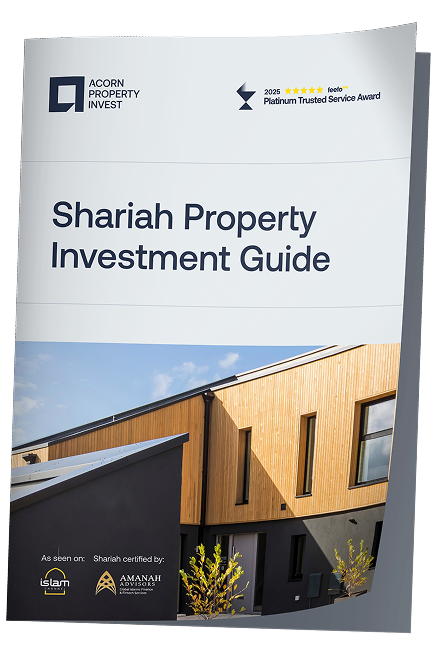
Download the Free Shariah Property Investment Guide
Everything you need to understand halal property investment in the UK, in one plain-English document.
- Plain-English explanation of riba, sukuk, murabaha, and gharar
- How the investment structure avoids riba, gharar, and maysir
- Amanah Advisors' full Shariah certification documentation
- Current UK development pipeline overview and project timelines
- Scenario modelling and full risk disclosure
Free download. Capital at risk. Returns not guaranteed. Eligible investors only.

Capital at risk. Returns not guaranteed. This is not financial advice.
The content of the financial promotions on this website has not been approved by an authorised person within the meaning of the Financial Services and Markets Act 2000. Reliance on these promotions for the purpose of engaging in investment activity may expose an individual to a significant risk of losing all of the property or assets invested.
This document is issued to investment professionals within the meaning of Article 19 of the Financial Services and Markets Act (Financial Promotion) Order 2005; certified high net worth individuals within the meaning of Article 48; certified sophisticated investors within the meaning of Article 50; and self-certified sophisticated investors within the meaning of Article 50A. If you do not meet these criteria, you must take further advice before proceeding.
Investing in property development involves risks including loss of capital. Investments made through Acorn Property Group are not covered by the Financial Services Compensation Scheme (FSCS). Acorn Property Invest is the fundraising division of Acorn Property Group, a company registered in England and Wales.
Before you continue
Acorn Property Invest is the funding arm of Acorn Property Group, providing capital to support residential and mixed-use development projects across the UK.
UK financial regulation requires us to confirm your eligibility before we can share any further information.
Please select an investor type that applies to you.
This does not commit you to an investment, and this is a requirement to ensure you are a suitable investor.